Shipping from China to Amazon FBA UK means one continuous chain: supplier pickup in China, export clearance, ocean or air freight, UK import clearance with duty and import VAT, and final delivery to an Amazon fulfilment centre. Sunny Worldwide Logistics (SZ) Limited (SWWLS), a freight forwarder established in 1998, runs that entire chain under one roof - so sellers get one quotation, one tracking thread, and one party accountable for the cargo until it is booked in at the fulfilment centre.
FBA stock entering the UK is commercial inventory moving through formal import procedures, and it cannot be treated like a consumer parcel. Three rules shape everything that follows:
1. The importer of record needs a GB EORI number. A customs declaration cannot be filed without an Economic Operators Registration and Identification number for the importing entity.
2. Import VAT is charged on entry. VAT is assessed on the customs value plus freight and duty, and a VAT-registered importer can declare and recover it through postponed VAT accounting instead of paying cash at the border (gov.uk - check when you can account for import VAT on your VAT return.
3. The goods must be classified before they sail. The commodity code drives the duty rate, and it is looked up through the official UK Trade Tariff service.
In standard FBA arrangements Amazon does not act as the importer of record, so a non-UK seller sending stock to a UK fulfilment centre needs its own GB EORI and a UK VAT registration in place before the first shipment. The low-value relief for consignments of GBP 135 or less applies to parcels sent to consumers, not to bulk FBA inventory, which normally exceeds the threshold (gov.uk - tax and duty on goods sent from abroad. Treat clearance as a planned step with a named importer, not a paperwork afterthought.
A China-to-UK FBA shipment passes through seven operational stages. Each one has an owner, a document set, and a time window - the delays that hurt sellers almost always come from a stage that was left unmanaged.
|
Stage |
What happens |
Typical timing |
|
1. Supplier pickup |
Cargo collected from one or several factories, consolidated at a China warehouse |
1-2 days |
|
2. FBA prep |
Units labelled with FNSKU barcodes, poly-bagged or bundled per requirement, cartons sealed and labelled |
1-3 days |
|
3. Export clearance |
Export declaration filed in China; loaded and sailed or flown |
1-2 working days |
|
4. Main carriage |
Ocean freight to a UK port, or air freight to a UK airport |
25-35 days ocean / 3-7 days air |
|
5. UK import clearance |
Import declaration filed with the importer's GB EORI; duty and import VAT handled |
1-3 working days after arrival |
|
6. Inland delivery |
Trucking from port or airport to the fulfilment centre, or to a prep centre first |
1-3 days |
|
7. FC booking-in |
Delivery appointment at the fulfilment centre and acceptance of the shipment |
1-3 working days |
Door-to-door ocean transit from China to an Amazon UK fulfilment centre typically lands at 30-40 days all in, and air freight at 7-12 days. Schedules are confirmed at booking, because sailings and carrier rotations change through the year.
Amazon enforces its inbound rules at the door. A shipment that arrives with the wrong labels or a non-compliant pallet is refused or charged, no matter how well it was shipped. Four requirement groups matter most.
Shipment creation. All new FBA shipments must be created in Send to Amazon (or through Amazon's API), which generates the shipment ID and the labels that must travel with the goods (Amazon Seller Central - FBA shipment creation in Send to Amazon.
Unit-level labelling. Every unit needs an exterior scannable barcode or label carrying the scannable barcode plus the human-readable number, and it must stay visible and readable after packing (Amazon Seller Central - product packaging requirements .
Carton labelling. Each box in the shipment needs its own FBA box ID label printed from the Shipping Queue, and every pallet needs four labels (Amazon Seller Central - shipping label requirements, Amazon Seller Central - seller requirements for LTL, FTL and FCL deliveries.
Pallet specification. The UK uses a 1000 x 1200 mm pallet; the rest of the EU uses 800 x 1200 mm. If a single item cannot sit on the pallet without overhanging the edges, two pallets must be bundled rather than overhanging (Amazon Seller Central - shipping and routing requirements . Pallet weight must not exceed 500 kg, and double-stacked pallets are accepted where they can be safely loaded and unloaded (Amazon Seller Central - arranging an LTL or truckload delivery.
A simple rule prevents most refusals: confirm label artwork and pallet dimensions with your forwarder before the goods leave the factory, not after they reach the port.
Four items decide whether a shipment clears in days or sits at the port. A DDP or door-to-door service should handle all four, but the seller remains legally responsible for the accuracy of the declaration.
|
Item |
What it is |
Who handles it |
|
GB EORI number |
The customs identifier (beginning "GB") required to import into England, Wales or Scotland |
The importer of record - the seller, or the forwarder's UK entity under a DDP arrangement |
|
Commodity code |
The classification that sets the duty rate and any controls |
Declared by the broker; sellers should verify it matches the actual product (UK Trade Tariff (https://www.gov.uk/trade-tariff)) |
|
Import VAT (20%) |
VAT on the customs value plus freight and duty |
Accounted for at import; recoverable by a VAT-registered importer |
|
Postponed VAT accounting (PVA) |
Lets a VAT-registered importer declare and recover import VAT on the same VAT return instead of paying at clearance |
The importer, who must instruct the broker in writing |
Two details separate a clean entry from an expensive one. First, the customs value must reflect the true transaction value; an under-declared invoice is the fastest route to a post-clearance demand and penalties. Second, PVA is only available if the importer is UK VAT-registered and the broker is instructed in writing before the declaration is filed - retrofitting PVA after clearance is not possible.
Customs release is not market access. Products sold in Great Britain must also satisfy UK product regulation, and those obligations sit with the manufacturer and the importer.
The UK operates the UK Conformity Assessed (UKCA) marking alongside continued recognition of CE marking for the Great Britain market. Under current rules, the UKCA marking may be affixed to a label or an accompanying document rather than the product itself until 31 December 2027, and manufacturers may use EU-recognised conformity processes to mark products for the GB market (gov.uk - placing UKCA or CE marked products on the market in Great Britain.
Two practical consequences for sellers shipping from China:
1. Importer identification details must appear on the product - name, trade name or trademark and a postal address. For a Chinese manufacturer selling through a UK Amazon account, this is often the first compliance gap found at inspection.
2. Sector rules sit outside the marking regime - electrical safety, batteries, packaging and waste obligations, toys, cosmetics and textiles each have their own requirements, collected in the government's A to Z of industry guidance (gov.uk - product safety for businesses: A to Z of industry guidance.
Send compliance documents - test reports, declarations of conformity, safety data sheets where applicable - to your forwarder at booking. If a shipment is selected for documentary or physical checks, having the file ready is the difference between a two-day release and a two-week hold.
Mode selection is a cost-versus-speed decision driven by volume and how urgently the listing needs stock. The table below reflects the options forwarders actually quote for China-to-UK FBA lanes.
|
Mode |
Best suited to |
Typical door-to-door transit |
What drives the cost |
|
LCL sea freight |
1-15 CBM, mixed or growing ranges |
30-45 days |
Chargeable volume in CBM, plus origin consolidation and destination handling |
|
FCL sea freight |
15 CBM and above, or fully palletised cargo |
30-40 days |
Container type (20ft or 40ft), not volume; lowest unit cost at scale |
|
Air freight |
100-500 kg, urgent restock |
7-12 days |
Chargeable weight (the greater of actual and volumetric weight) |
|
Express courier |
Samples and launch quantities under 100 kg |
3-7 days |
Cost per kilogram, highest of the four |
The practical break point sits around 15 CBM: below it, LCL shields the seller from paying for unused container space; above it, an FCL quote usually wins on unit cost and avoids destination deconsolidation. Air freight is a restock tool rather than a launch tool - it protects a best-seller ranking, it does not build a margin.
Port choice is made at booking and affects inland trucking cost more than sellers expect.
- Felixstowe - the UK's largest container port, handling the largest share of the country's containerised trade and the main deep-sea gateway for Far East services (Port of Felixstowe.
- London Gateway - the deep-water terminal on the Thames operated by DP World, currently being expanded under a GBP 1 billion programme intended to make it the UK's largest container port (DP World - London Gateway.
- Southampton - the south-coast alternative, frequently used when sailings or space dictate.
From whichever gateway the container discharges, Amazon's UK network is reached by road. Amazon operates a national system of fulfilment centres, sortation centres and delivery stations, and inbound stock is routed to the facilities Amazon allocates in Send to Amazon rather than to a location the seller chooses (About Amazon UK - fulfilment centres explained. That is why a forwarder who quotes a single inland delivery rate, without checking the allocated fulfilment centre postcode, is quoting a number that may change.
1. No GB EORI or UK VAT registration when the shipment is booked. Clearance cannot start without them, and the container keeps accruing storage from arrival day.
2. Labels produced without checking Send to Amazon. FNSKU unit labels and box ID labels must match the shipment as created; factory-produced artwork that predates the shipment plan is a common cause of refusal.
3. Pallet specification ignored. Wrong pallet size, overhanging cartons, or pallets above 500 kg are rejected or require reworking at the port.
4. Commodity code or value guessed. A wrong code changes the duty rate, and an under-declared value invites a post-clearance demand and penalties.
5. Booking too late in peak season. From September to November, Asia-UK space tightens and fulfilment centre appointments queue - shippers who book 4-6 weeks ahead protect their launch dates.
SWWLS operates against a single seven-step process, with an accountable owner on each step and a time window confirmed at booking.
|
Step |
Process |
Indicative timing |
|
1 |
Booking, shipment review and export documentation |
Same day |
|
2 |
Supplier pickup and consolidation, using SWWLS's own trucking fleet at Shenzhen sea port |
1-2 days |
|
3 |
FBA prep: FNSKU labelling, box and pallet labelling, carton sealing |
1-3 days |
|
4 |
Export customs clearance in China |
1-2 working days |
|
5 |
Main carriage by sea or air to the UK gateway |
25-35 days sea / 3-7 days air |
|
6 |
UK import clearance with duty and import VAT handling, including postponed VAT accounting where the importer qualifies |
1-3 working days after arrival |
|
7 |
Inland delivery and fulfilment centre appointment |
1-3 working days |
Why sellers consolidate the whole chain with SWWLS:
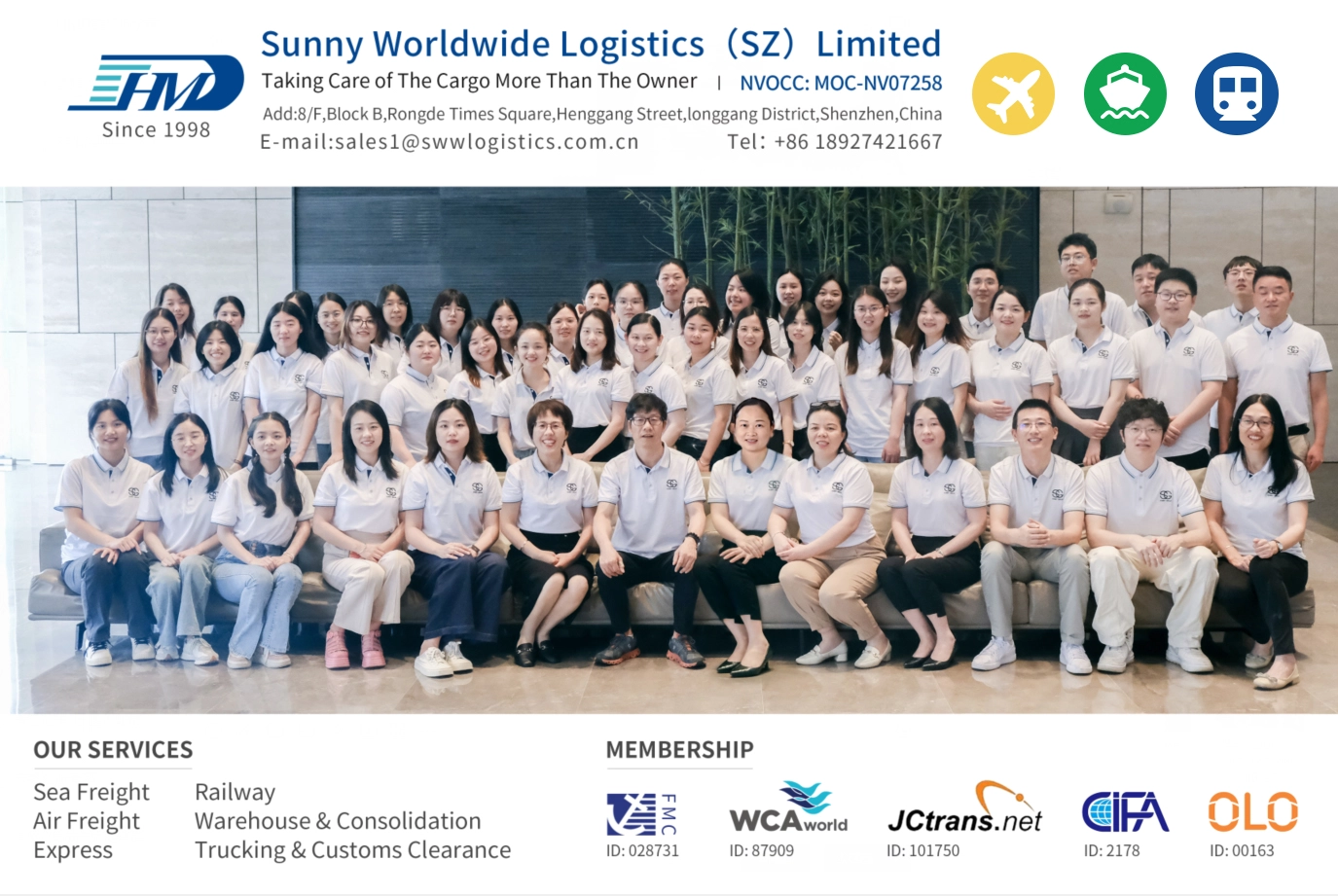
- Established 1998, more than 20 years in international freight - a full-service domestic and international forwarder based in China
- Own trucking company at Shenzhen sea port - direct control of the first mile, which is where missed cut-offs originate
- 1,800 sqm Class A office - dedicated operations, documentation and customer service teams rather than a single account handler
- UK compliance experience - EORI-based import entries, import VAT and postponed VAT accounting documentation for FBA programmes
- One accountable party - sea, air, customs brokerage, inland trucking and final-mile delivery under one roof
Three moves keep a China-to-UK FBA pipeline predictable:
1. Fix the import identity before the first shipment. A GB EORI and, for non-UK sellers holding stock in the UK, a UK VAT registration - both in place before booking. Nothing downstream can be fixed retroactively.
2. Send the Send to Amazon artwork to the prep team. FNSKU labels, box ID labels and pallet labels should be generated from the live shipment, then verified against the packing plan before the cartons are sealed.
3. Book 4-6 weeks ahead in peak season and ask for an all-in landed cost. A door-to-door quotation that states what is included for duty and import VAT removes the surprise invoice at the fulfilment centre door.
If a product is regulated - electricals, batteries, toys, cosmetics - share the certificates at booking so that customs and market-surveillance documentation can be reviewed before the cargo moves.
Q: How long does shipping from China to Amazon FBA UK take?
A: Ocean freight from China to a UK port typically takes 25-35 days, and door-to-door delivery to a fulfilment centre usually lands at 30-40 days including export clearance, UK import clearance and the Amazon delivery appointment. Air freight runs 7-12 days door to door. Confirm the sailing or flight at booking, as schedules change seasonally.
Q: What documents are needed to ship from China to Amazon FBA UK?
A: A commercial invoice, packing list, bill of lading or air waybill, the importer's GB EORI number, and the commodity code for each product. FBA shipments also need FNSKU unit labels, FBA box ID labels from Send to Amazon, and four pallet labels per pallet. Sector documents such as test reports should be shared at booking.
Q: Do I need a GB EORI and UK VAT registration to send stock to FBA in the UK?
A: In practice, yes. The importer of record needs a GB EORI number to file the import declaration, and non-UK sellers holding inventory in the UK normally need a UK VAT registration. Both should exist before the shipment sails, because Amazon may refuse inbound stock without a verifiable importer of record.
Q: Who is the importer of record for an FBA shipment to the UK?
A: In standard FBA arrangements Amazon does not act as importer of record, so the seller is normally the importer - or the forwarder's UK entity does so under a DDP arrangement. Whoever acts as importer must hold the GB EORI, be reachable by the customs broker, and be able to account for import VAT.
Q: What are Amazon's pallet requirements for UK fulfilment centres?
A: UK fulfilment centres use 1000 x 1200 mm pallets, while the rest of the EU uses 800 x 1200 mm. Pallets must not exceed 500 kg, four labels are required on each pallet, and cargo must not overhang the pallet edges. Double-stacked pallets are accepted when they can be safely handled.
Talk to the SWWLS team for an all-in door-to-door quote for your Amazon FBA shipments from China to the UK - supplier pickup, FBA prep and labelling, export clearance, ocean or air freight, UK import clearance with duty and import VAT handling, and delivery to your Amazon fulfilment centre.