𝐂𝐨𝐧𝐭𝐚𝐢𝐧𝐞𝐫 𝐦𝐢𝐬𝐦𝐚𝐭𝐜𝐡 𝐜𝐨𝐬𝐭𝐬 𝐠𝐥𝐨𝐛𝐚𝐥 𝐬𝐡𝐢𝐩𝐩𝐞𝐫𝐬 𝐚𝐧 𝐞𝐬𝐭𝐢𝐦𝐚𝐭𝐞𝐝 $𝟏.𝟐𝐁 𝐚𝐧𝐧𝐮𝐚𝐥𝐥𝐲.
The data is clear: → 37% of cargo damage claims involve "preventable container selection errors" → 28% of demurrage fees stem from incompatible equipment choices → 15% margin erosion traces back to paying for unused container capacity
Strategic container selection isn't logistics — it's revenue protection.
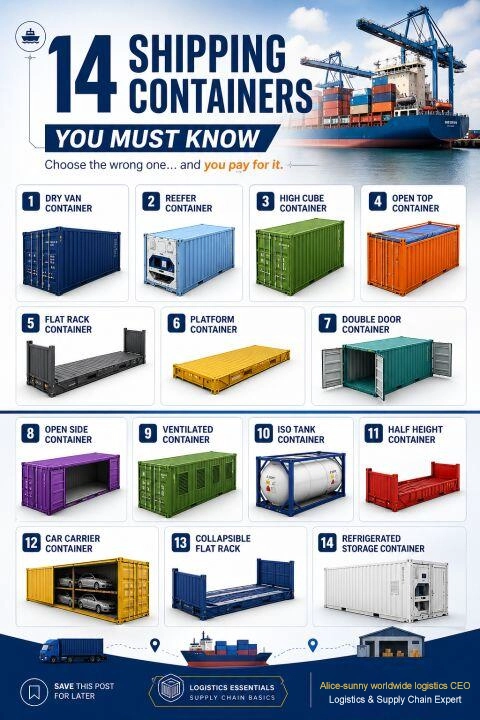
The 14 Container Archetypes Every Supply Chain Leader Should Deploy:
1️⃣ Standard Dry Container Your workhorse for 80% of cargo. Enclosed steel box for general goods — electronics, textiles, boxed products. Choose this when: cargo doesn't need temperature control and fits standard dimensions.
2️⃣ Refrigerated Container (Reefer) Not just "a cold box" — it's active climate management. For pharmaceuticals, frozen food, fresh produce. Choose this when: temperature deviation = product failure.
3️⃣ High Cube Container 20% more volume than standard, same footprint. Perfect for lightweight bulky items — furniture, apparel, hollow products. Choose this when: you're paying by container, not by weight.
4️⃣ Open Top Container Removable roof for crane loading. Essential for tall machinery, glass panels, manufacturing equipment. Choose this when: cargo height exceeds 2.59m or requires top access.
5️⃣ Flat Rack Container No walls, just a reinforced floor. For construction equipment, boats, oversized machinery. Choose this when: cargo width/length exceeds standard container dimensions.
6️⃣ Platform Container Flat rack without even the end walls. For exceptionally heavy industrial loads requiring custom securing. Choose this when: you need maximum flexibility in load distribution.
7️⃣ Tunnel Container (Double Door) Doors at both ends = faster loading cycles. Ideal for warehouses with drive-through access or mixed cargo requiring sequential unloading. Choose this when: time efficiency matters more than slight cost premium.
8️⃣ Side Opening Container Full lateral access along the container length. Game-changer for wide cargo, pallet operations, or goods that can't turn corners. Choose this when: forklift access from the side saves hours.
9️⃣ Ventilated Container Passive airflow through vents in walls. Critical for coffee beans, cocoa, onions — cargo that generates moisture but doesn't need refrigeration. Choose this when: condensation is your enemy but cooling isn't necessary.
🔟 ISO Tank Container DOT-certified for bulk liquids, chemicals, gases. Built-in heating/cooling options available. Choose this when: transporting 21,000+ liters of hazardous or food-grade liquids.
1️⃣1️⃣ Half-Height Container Lower profile, reinforced floor for ultra-dense cargo. Stone, scrap metal, coal — anything where weight maxes out before volume. Choose this when: your cargo density exceeds 2 tons per cubic meter.
1️⃣2️⃣ Car Carrier Container Internal racking systems with tie-down points specifically engineered for vehicles. Choose this when: shipping cars, motorcycles, or equipment requiring zero movement during transit.
1️⃣3️⃣ Collapsible Flat Rack Foldable sides reduce empty repositioning costs by 75%. Choose this when: you need flat rack capability but want to minimize deadhead expenses.
1️⃣4️⃣ Portable Reefer Unit Stationary cold storage, not for transport. Handles overflow during peak seasons or temporary warehousing needs. Choose this when: you need flexible cold chain capacity without permanent infrastructure.
Category A: General Purpose Containers
Standard Dry Van — The baseline. Accounts for 85% of global container movements. Deploy for: non-perishable, dimensionally-compliant general cargo.
High Cube Variant — 13.7% additional cubic capacity. Deploy for: maximizing volume efficiency on lightweight, bulky SKUs.
Double-Door Configuration — Dual-access points reduce handling time by 40%. Deploy for: time-sensitive warehouse operations requiring rapid turnaround.
Category B: Controlled Environment Solutions
Refrigerated Units (Reefer) — Active temperature management -35°C to +30°C. Deploy for: cold chain integrity requirements where temperature deviation = product failure.
Ventilated Designs — Passive airflow management without refrigeration. Deploy for: moisture-generating agricultural products requiring air circulation.
Portable Cold Storage — Stationary units for overflow capacity. Deploy for: seasonal demand spikes without permanent infrastructure investment.
Category C: Specialized Heavy & Oversized Equipment
Flat Rack Containers — Open-side loading for dimensional flexibility. Deploy for: cargo exceeding 2.35m width or 12m length.
Platform Containers — Maximum load distribution flexibility. Deploy for: industrial equipment requiring custom securing patterns.
Collapsible Flat Rack — Foldable design reduces repositioning costs 60-75%. Deploy for: optimizing empty container logistics economics.
Category D: Dimensional Variants
Open Top Containers — Removable roof for crane-loaded cargo. Deploy for: height-exceeding loads or goods requiring vertical extraction.
Side-Opening Containers — 100% lateral access across 12m length. Deploy for: wide cargo or pallet-dense operations requiring forklift efficiency.
Half-Height Containers — Reduced cubic volume, reinforced floor capacity. Deploy for: ultra-dense cargo (>2 MT/m³) where weight limits before volume.
Category E: Niche Applications
ISO Tank Containers — Bulk liquid transport with DOT compliance. Deploy for: 21,000L+ volumes of chemicals, food-grade liquids, or gases.
Vehicle Carrier Units — Integrated securing systems for automotive transport. Deploy for: zero-movement requirements during intercontinental vehicle logistics.
The Competitive Advantage:
Companies that treat container selection as strategic resource allocation rather than operational procurement achieve: ✓ 12-18% lower total landed costs ✓ 67% fewer damage claims ✓ 23% reduction in supply chain variability
The question isn't whether you know these container types. The question is whether your procurement process optimizes for them.