If you are looking for Freight Forwarder China To USA Amazon FBA, then you must pay attention to Sunny Worldwide Logistics. Since Amazon launched FBA warehouses, we have been providing Freight Forwarder China To USA Amazon services. Our boss started working in freight forwarding in 1998, and by 2026, he has 28 years of industry experience. The Amazon FBA problems you encounter are problems we have experienced before, and we have solutions for all of them.
Work as your main USA Amazon FBA shipping guide. It should target keywords such as shipping from China to Amazon FBA, shipping from China to Amazon FBA USA, how to ship from China to Amazon FBA, China to Amazon FBA, and Amazon FBA freight forwarder China.
1、Air freight for faster delivery
2、Sea freight for lower cost shipping
3、Amazon FBA shipping solutions
4、Door to door services like DDP shipping from China for air or sea shipments
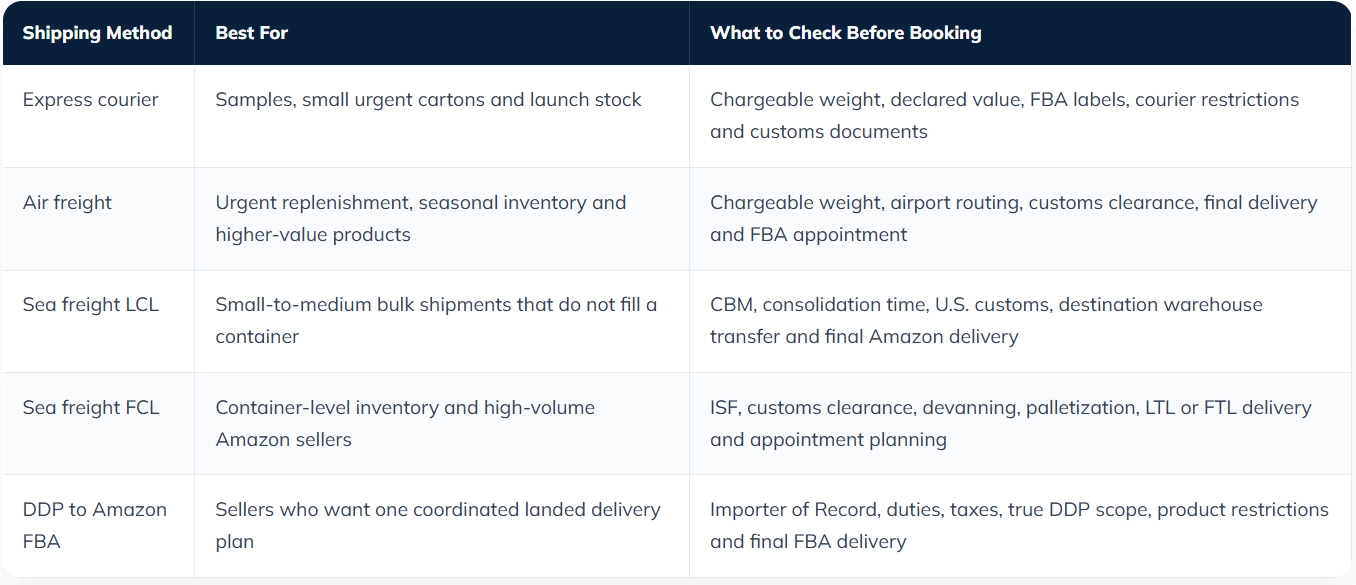
Choosing the right shipping method may seem simple, but it is actually not easy. You need to consider factors such as product type, FBA label status, customs risks, delivery time, and shipping costs.Our sales team will provide each customer with 3 logistics solutions based on the products and delivery requirements you provide, helping you save at least 5% in costs.
The core of the FBA process is to ensure that every step from supplier pickup to Amazon warehouse receiving has clear responsibilities and effective control points. A complete FBA supply chain process should cover cargo receiving, compliance preparation, export transportation, and final delivery management.
1、Cargo Pickup and Receiving Inspection
Goods are collected from one or multiple suppliers and inspected before shipment, including product name, material, photos, carton quantity, weight, dimensions, and cargo value. This ensures the shipment meets all requirements for the next stage of transportation.
2、FBA Preparation and Compliance Review
Before shipment, complete the review of FBA labels, packaging, pallets, and carton requirements. Prepare shipment IDs and destination warehouse codes, and correct any issues that do not meet Amazon FBA receiving standards to reduce the risk of rejection or delays.
3、Selecting the Right Shipping Method
Based on the delivery deadline, cargo volume, and product characteristics, compare different shipping options, including express, air freight, sea freight, DDP, LCL, FCL, LTL, and FTL, to select the most suitable solution.
4、Preparing Export Documentation
Prepare and verify commercial invoices, packing lists, HTS codes, declared values, and importer responsibilities. Ensure customs documents, shipping routes, and cargo information remain consistent to avoid customs clearance delays caused by documentation or compliance issues.
5、Customs Clearance and Final Delivery
After the goods arrive in the destination country, complete import customs clearance, cargo pickup, and Amazon delivery appointment procedures. For shipments requiring formal import declaration, coordinate with customs brokers in advance to ensure the goods are delivered to the FBA warehouse as scheduled.
Before goods are delivered to an Amazon FBA warehouse, meeting Amazon’s receiving requirements is a critical part of the entire cross-border logistics process. Sellers need to pay attention not only to product packaging, labeling, and delivery requirements, but also to verify shipping documents, import compliance, and warehouse receiving conditions in advance. This helps ensure smooth customs clearance and FBA delivery while reducing delays and additional costs caused by compliance issues.
Amazon fulfillment centers strictly require advance appointments for LTL (Less Than Truckload) and FTL (Full Truckload) deliveries. If the carrier fails to secure a delivery appointment through Carrier Central, the shipment may be held at a transfer facility, resulting in additional costs such as storage fees, pre-pull charges, and redelivery expenses.
In many cases, these issues originate from upstream preparation errors, including inaccurate carton quantities, unconfirmed pallet information, or conflicts between cargo handover schedules and Amazon delivery appointments. Once the initial appointment fails, each recovery step can create a chain reaction, increasing costs and significantly delaying overseas inventory replenishment plans.
Any unscannable FNSKU labels, overweight cartons without required warning labels, or non-compliant pallets may result in the fulfillment center dock directly refusing the shipment. Once the goods are rejected, the resulting chain reactions, including local rework, rescheduling, and missed replenishment windows, can quickly reduce product profits.
In actual operations, the highest-risk shipments often come from relying too much on suppliers’ own interpretation of Amazon FBA preparation guidelines. If your team still needs to confirm the specific requirements for FBA labels and packaging, a complete inspection must be completed before the goods are exported. Do not attempt to fix these issues after the container or LCL shipment has already been shipped.
The Sunny Worldwide Logistics team not only helps Amazon FBA customers check labeling requirements, but also assists customers who forget to apply labels or apply incorrect labels. We even provide free label correction and relabeling services.
Amazon may serve as the final delivery address or warehouse receiving location for goods, but it does not necessarily assume the legal responsibility of the Importer of Record (IOR). For shipments transported across borders to Amazon FBA warehouses, the determination of the importer of record, customs declaration responsibilities, and preparation of related compliance documents must be planned before the goods enter the destination country.
If the shipment lacks required import documents, regulatory permits, customs bond information, or if products subject to U.S. FDA, FCC, and other regulatory requirements have not completed the necessary certifications and declarations, customs and relevant regulatory authorities have the right to inspect, detain, or even refuse release of the goods before they reach the final delivery location.
Some sellers mistakenly confuse Amazon FBA’s warehousing and fulfillment services with import compliance responsibilities. In reality, FBA is only responsible for storage, fulfillment, and order delivery after the goods are received into the warehouse. It does not replace the seller’s responsibilities for import declarations, duty payments, product compliance, or customs obligations.
Therefore, before arranging international shipments to Amazon warehouses, sellers should integrate Importer of Record confirmation, trade document review, product regulatory assessment, and destination-country compliance preparation into a unified supply chain management process. Only by ensuring import compliance can an FBA delivery plan be successfully executed.
A multi-factory sourcing model without unified coordination can increase management costs across procurement, consolidation, warehousing, and transportation, while also raising the risk of order delays and delivery disruptions. If logistics quotations do not fully include origin-side costs, peak season surcharges, pickup fees, warehouse handling costs, and additional storage fees caused by missed shipping schedules or delivery windows, the actual logistics cost may be significantly higher than expected.
Profit losses in cross-border supply chains are often not caused by a single major expense, but by accumulated hidden costs across multiple stages. For example, when supplier management, production coordination, inventory preparation, export customs clearance, and freight booking are handled by different parties without a unified supply chain coordinator, information flow becomes less efficient, responsibilities become unclear, and overall delivery risks increase.
Therefore, accurate Landed Cost calculation depends not only on transportation rates but also on the overall coordination of procurement, logistics, customs clearance, warehousing, and final delivery processes. Establishing a unified supply chain execution system, identifying costs in advance, and managing each stage effectively are key to reducing hidden expenses, controlling delivery risks, and improving profit predictability.
1、Origin-Side Costs and Key Considerations
Before goods are shipped to Amazon FBA warehouses, origin-side preparation directly impacts overall transportation efficiency and final Landed Cost. Sellers should evaluate the following key factors in advance:
Factory location and the distance to the loading port:
The location of different factories can affect domestic transportation costs, pickup efficiency, and export arrangements. A suitable consolidation plan should be prepared in advance.
Number of suppliers and coordination complexity:
The more suppliers involved, the higher the costs associated with communication, inspection, cargo consolidation, and time management.
Packaging and export preparation requirements:
Processes such as carton labeling, FBA labeling, pallet preparation, and packaging inspection require sufficient preparation time. Failure to meet requirements may delay shipment schedules.
Accuracy and completeness of export documents:
Commercial invoices, packing lists, customs declaration documents, and other export documents must be reviewed before the cargo cutoff date to avoid delays or additional costs caused by documentation errors.
When multiple factories ship according to different production schedules and timelines, or when sellers need additional services in China before export, such as inspection, labeling, repackaging, or cargo consolidation, origin-side costs can increase significantly. (Sunny Worldwide Logistics previously handled shipments from 44 suppliers, consolidating goods where the volume is highest.)
If goods require collection, inspection, sorting, labeling, or reorganization before container loading or export, the resulting warehousing, handling, and consolidation costs are actually part of the overall Landed Cost and should not be considered unexpected expenses after transportation begins.
Therefore, when planning an FBA shipping strategy, sellers should include origin operations, supplier coordination, and export preparation as part of the overall supply chain planning process, rather than focusing only on international freight costs.
2、Key Considerations During Amazon FBA International Transportation
The international transportation stage involves more than just ocean freight costs and transit time. It also includes route selection, customs compliance, import risks, and destination-country regulatory requirements. When arranging FBA shipments, sellers should pay close attention to the following factors:
Shipping routes, transit ports, and seasonal capacity changes:
Different shipping routes, transshipment points, and peak/off-season capacity fluctuations can affect transit times, space availability, and overall logistics costs. Proper planning and risk management should be prepared in advance.
Import bond requirements and submission procedures:
According to destination-country customs regulations, certain shipments may require an import bond. The type of bond, application process, and submission timing can all affect customs clearance progress.
HS Code classification and responsibility assessment:
Accurate HS Code classification directly affects tariff rates, regulatory requirements, and the allocation of import responsibilities. Incorrect classification may result in additional duties, customs inspections, or shipment delays. Sunny Worldwide Logistics Proficient in customs codes and accurate product classification,When product coding is disorganized, we redesign and refine shipping marks to simplify inventory checks and cargo verification. Others may do it, but rarely with such attention to detail.
MPF (Merchandise Processing Fee), Customs Inspection Risks, and Regulatory Compliance Costs:
In addition to basic transportation costs, the import process may involve customs processing fees, inspection charges, safety certification review fees, and other compliance-related expenses.
The intermediate stages of transportation are often the key reason why different logistics quotations cannot be directly compared. Even if two shipments have similar ocean freight rates, the final Landed Cost may vary significantly after considering import bond requirements, tariff risks, customs inspection probabilities, and declaration complexity.
Therefore, for non-standardized shipments or imports with higher regulatory requirements, advance import planning and professional customs broker support can effectively reduce the risks of unexpected costs, customs clearance delays, or compliance issues after the goods arrive at the destination. With 28 years of cooperation, customs authorities trust Sunny Worldwide Logistics.
3、Key Considerations During the Amazon FBA Destination Delivery Stage
Arrival at the destination port does not mean the logistics process is complete. Destination-side operations, including port handling, inland transportation, delivery appointments, and FBA warehouse receiving procedures, can directly affect final delivery costs and warehouse receiving efficiency. Sellers should pay close attention to the following areas:
Port congestion, chassis availability, and container pickup efficiency:
Port congestion, chassis shortages, and terminal pickup restrictions may result in additional demurrage fees, detention charges, and transportation delays.
FCL deconsolidation, LCL handling, and container return arrangements:
When full container shipments are transferred for deconsolidation or LCL processing, proper planning of unloading schedules, warehouse arrangements, and empty container return timing is essential to avoid unnecessary handling costs.
Parcel Injection and LTL/FTL appointment delivery management:
Selecting the right final delivery method based on cargo type, shipment volume, and Amazon FBA warehouse requirements is critical. Whether using Parcel Injection, Less Than Truckload (LTL), or Full Truckload (FTL) delivery, appointment procedures and delivery requirements must be confirmed in advance.
Pre-pull, short-term storage, and redelivery risks:
If goods cannot be delivered according to Amazon’s scheduled appointment window, temporary storage, pre-pull arrangements, or delivery rescheduling may be required, resulting in additional costs.
The destination delivery stage is often one of the areas where logistics costs fluctuate the most. When the final delivery timing does not match Amazon FBA’s receiving window, even if the ocean freight pricing and transportation plan are already confirmed, missed appointments, pre-pull operations, port waiting time, and temporary storage issues can significantly increase the actual Landed Cost.
Therefore, destination execution should not be treated simply as an additional “last-mile delivery” service. It should be planned as an integral part of the entire FBA supply chain solution. Only by coordinating port operations, customs clearance, inland transportation, and Amazon FBA delivery appointments can sellers effectively control logistics costs and reduce warehouse receiving risks.
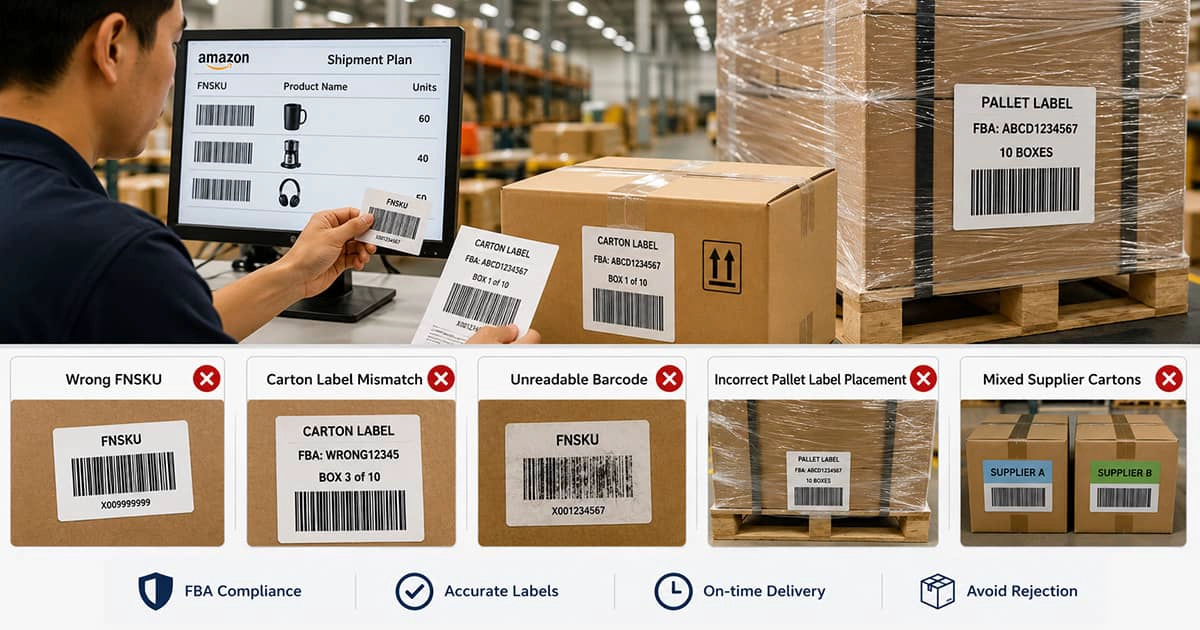
1. Incorrect FNSKU on Products
Suppliers may use outdated files, incorrect SKUs, or mixed label batches, causing Amazon to receive incorrect products or hold shipments for review.
Solution: Match FNSKU files with the SKU list and actual product photos before shipment.
2. Mismatched Carton Labels
If carton labels do not match the shipment plan, carton quantity, or destination warehouse, Amazon may be unable to correctly scan and identify the shipment.
Key Check: Verify that every carton label includes the shipment ID, carton number, and total carton quantity.
3. Unreadable Barcodes
Barcodes that are blurry, folded, scratched, covered by tape, or printed too small may prevent receiving staff from scanning the products or cartons efficiently.
Key Check: Scan sample labels before sealing cartons to confirm barcode readability.
4. Incorrect Pallet Label Placement
Missing pallet labels, labels placed under stretch wrap, or labels attached on only one side may prevent LTL carriers or receiving teams from properly identifying pallets.
Key Detail: After the final pallet wrapping is completed, place pallet labels on visible sides to ensure easy scanning and identification.
5. Mixed Supplier Cartons
Cartons from Supplier A and Supplier B may be combined without proper SKU sorting, causing incorrect cartons to be included in the wrong FBA shipment or requiring additional warehouse sorting.
Key Detail: Separate supplier batches, relabel cartons after consolidation, and take photos of the final cartons before shipment.
Yes, but only if the supplier has complete FBA operational capabilities and is familiar with Amazon’s labeling requirements, packaging standards, shipment IDs, export documents, and FBA receiving procedures.
Direct supplier-to-FBA shipping is more suitable for single-SKU products, standardized packaging, simple orders, and suppliers with actual FBA experience. When dealing with multiple SKUs, multiple suppliers, non-compliant packaging, missing labels, unclear product compliance, or incomplete import documentation, direct shipping may increase the risk of FBA receiving issues.
If you are unsure whether a supplier can handle direct FBA shipments, using a China warehouse for pre-export processing is recommended. The warehouse can handle cargo receiving, quantity inspection, label verification, carton measurement, supplier consolidation, repackaging, and FBA shipment preparation, reducing potential transportation and receiving problems.
For sellers who purchase from multiple suppliers, require warehouse consolidation, need FBA label inspections, want to compare DDP and non-DDP options, need tariff evaluation, or require accurate Amazon warehouse delivery appointments, choosing an experienced FBA freight forwarder such as Sunny Worldwide Logistics is usually a more effective solution.
Sunny Worldwide Logistics specializes in international freight forwarding services, including ocean freight, land transportation, air freight, and import/export cargo transportation. Our services cover cargo collection, booking, warehousing, transit handling, container loading and unloading, freight settlement, customs declaration, inspection services, cargo insurance, local trucking, container pickup, cargo consolidation, warehouse value-added services, cargo handling, integrated logistics projects, and customized logistics solution planning.
1、Product name, photos, and product links:
Help verify cargo type, shipping restrictions, and potential customs risks.
2、Supplier city in China:
Affects pickup costs, domestic transportation, and origin routing options.
3、Carton quantity, gross weight, and dimensions:
Used to calculate chargeable weight, CBM, and handling costs.
4、Cargo value and HTS Code (if available):
Helps estimate duties, tariffs, and customs requirements.
5、Amazon shipment ID and FBA warehouse code:
Required for destination planning, delivery appointments, and final delivery cost calculation.
6、Labeling and preparation status:
Shows whether FBA label inspection, relabeling, or warehouse preparation services are required.
7、Required delivery date and preferred shipping method:
Helps compare different options, including express shipping, air freight, ocean freight, DDP, LTL, and FTL.
By providing the above information, the sales team at Sunny Worldwide Logistics can provide an accurate quotation in a timely manner. Once a contract is signed, there are no hidden charges or additional fees. Customers can also use Alibaba Trade Assurance for secured transactions. We are a 16-year experienced Alibaba Gold Supplier. Shipping Agent In China For Alibaba
Sunny Worldwide Logistics Services for Amazon FBA Shipments from China to USA
We help Amazon sellers ship goods from China to USA FBA warehouses safely and efficiently. Based on different products and supply chain situations, we provide at least 3 transportation solutions for each customer to optimize costs, reduce risks, and manage the complete process from supplier pickup to FBA warehouse delivery.
1. Supplier Pickup in China
Coordinate cargo pickup from factories, trading companies, or warehouses to ensure smooth shipment preparation and transportation.
2. China Warehouse Consolidation Services
Provide cargo receiving, inspection, measurement, photography, repackaging, and consolidation of goods from multiple suppliers.
3. FBA Label and Packaging Inspection
Check FNSKU labels, FBA carton labels, carton dimensions, and shipping information to reduce the risk of Amazon receiving issues.
4. Multi-Supplier Order Consolidation
Coordinate goods from different suppliers, optimize export arrangements, and reduce overall transportation costs. We have previously handled shipments consolidated from 44 different suppliers into one shipment plan.
5. Ocean Freight and Air Freight Comparison
Provide the most suitable transportation solutions based on delivery deadlines, costs, and inventory requirements.
6. DDP and Non-DDP Solution Planning
Evaluate duties, customs clearance responsibilities, import requirements, and final delivery methods.
7. FBA Warehouse Delivery Planning
Arrange final delivery based on FBA warehouse codes, cargo characteristics, and appointment requirements.
8. Export and Customs Document Review
Review commercial invoices, packing lists, product descriptions, declared values, and HTS codes to ensure smooth customs clearance.
Express shipping may take several business days after pickup. Air freight usually takes around 1–2 weeks for door-to-door delivery. Ocean freight may take several weeks, depending on the shipping route, customs clearance process, destination warehouse, and final delivery arrangements.